

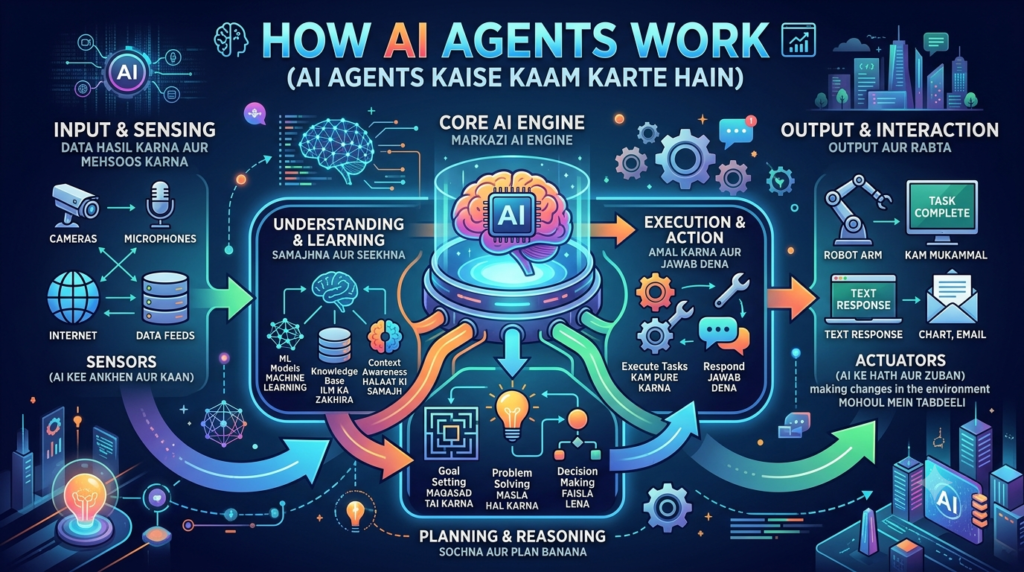
How Do AI Agents Work? Explained Step by Step with Real Examples
Artificial Intelligence (AI) is advancing at an incredible pace, moving well beyond basic chatbots and traditional rule-based software. One of the most significant breakthroughs is the emergence of AI agents—intelligent systems that can understand objectives, make informed decisions, use digital tools, and carry out complex tasks with little or no continuous human guidance.
As organizations increasingly adopt automation, AI agents are becoming a key technology across industries. They are helping businesses streamline operations, assisting developers with coding, supporting healthcare professionals in analyzing data, improving customer service through intelligent interactions, and boosting personal productivity by handling repetitive or time-consuming work.
Unlike conventional software that follows a fixed sequence of instructions, AI agents are designed to think in terms of goals. They can gather information from various sources, evaluate possible actions, create plans, interact with external applications, and adjust their behavior whenever new information becomes available. This ability to reason, adapt, and act independently makes AI agents far more flexible than traditional automation systems.
Understanding how AI agents work is increasingly important as they reshape how people and businesses use technology. Whether you’re learning about AI for the first time or exploring advanced automation solutions, knowing the principles behind AI agents will help you better understand their growing impact.
In this comprehensive guide, you’ll discover:
- What AI agents are and why they matter
- How AI agents work, explained step by step
- The essential components that power an AI agent
- Practical examples of AI agents in everyday use
- The differences between AI agents and traditional chatbots
- The major advantages, current limitations, and future possibilities of AI agent technology
By the end of this article, you’ll have a solid understanding of how AI agents operate, where they are being used today, and why they are expected to play a central role in the future of intelligent automation.
What is an AI Agent?
An AI agent is an advanced software entity engineered to perceive environmental data, process it intelligently, make autonomous decisions, and execute actions to fulfill a predefined objective.
Unlike conventional programs that rely on continuous user instructions, an AI agent independently evaluates a task, formulates an optimal strategy, and manages multi-step workflows to achieve the desired result.
In simple terms, think of an AI agent as a highly autonomous digital assistant. It doesn’t just answer queries; it actively executes complex operational tasks such as data gathering, report generation, meeting coordination, code writing, and end-to-end workflow management.
Key Characteristics of AI Agents
Most operational AI agents exhibit the following core attributes:
- Goal-Oriented: They align all processing and actions toward achieving a specific outcome.
- Advanced Reasoning: They possess cognitive-like abilities to analyze complex problems and derive solutions.
- Strategic Planning: They map out a sequence of actions before executing a task.
- Contextual Memory: They retain and utilize relevant historical data throughout a workflow.
- Tool Integration: They seamlessly interact with external applications, databases, and APIs.
- Dynamic Adaptability: They can pivot and adjust their strategy when encountering shifting data or unexpected variables.
These sophisticated capabilities make AI agents significantly more versatile and robust than legacy software systems.
AI Agent vs. Traditional Software
Traditional software operates strictly on rigid, developer-defined logic (rule-based). It executes exact commands sequentially and lacks the capacity to adapt to scenarios outside its original codebase.
Conversely, an AI agent leverages contextual understanding and real-time reasoning to determine the most effective method for accomplishing a goal.
Comparative Overview
| Feature | Traditional Software | AI Agent |
| Core Logic | Rule-based and static | Goal-oriented and intelligent |
| Workflow | Fixed and unyielding | Dynamic and flexible |
| Adaptability | Extremely limited | High context-awareness |
| Execution | Follows predefined scripts | Determines the optimal next action |
| Autonomy | Requires constant manual guidance | Executes complex multi-step tasks independently |
For Example: A standard calculator app simply processes mathematical formulas based on immediate user inputs (Traditional Software). However, an AI agent given a prompt like, “Analyze last quarter’s sales metrics, identify growth trends, compile an executive summary, and dispatch it to the marketing department,” will orchestrate and complete every phase of that workflow autonomously.
How do AI agents work?
While architecture varies across systems, the operational lifecycle of a standard AI agent can be broken down into clear, structured stages.
Phase 1: Input Ingestion
Every AI agent initiative triggers from a baseline input signal. This data stream can originate from diverse vectors, including:
- Direct user prompts or text queries
- Vocal/voice commands
- Digital form submissions
- Enterprise software applications
- IoT hardware or environmental sensors
- API requests and automated database updates
Step 2: Comprehend and Analyze the Request
Once the input is received, the AI agent evaluates the user’s intent rather than just reading the literal words. During this phase, it identifies:
- The primary objective
- Essential keywords and parameters
- Defined constraints or limitations
- The expected output format
- Accessible resources and databases
Using the previous example (“Find the five best AI tools for content marketing and summarize their features”), the agent deduces that it must locate relevant platforms, analyze their core functionalities, extract key highlights, and structure the data into an easy-to-read layout.
Step 3: Formulate a Strategic Plan
A defining feature of an advanced AI agent is its capacity for strategic planning. Instead of generating an immediate, unstructured response, it breaks the overarching goal down into sequential, manageable milestones:
- Query trusted databases for top-tier content marketing AI tools.
- Extract specific operational details and features for each tool.
- Conduct a comparative analysis of their strengths and limitations.
- Synthesize the findings into concise summaries.
- Compile the final data into a clean, professional report.
This systematic planning ensures the agent resolves complex workflows with high efficiency and accuracy.
Step 4: Leverage Memory and Context
To deliver precise results, AI agents rely on internal memory systems. This allows them to retain critical data across an active workflow or across multiple interactions, such as:
- Historical user instructions
- Outcomes from previous steps
- Corporate guidelines and operational rules
- Specific project requirements
- Ongoing conversation history
- Current workflow milestones
Contextual Example: If a user previously specified that all marketing documents must align with a formal brand voice, the AI agent retains this preference and automatically applies a professional tone to any newly generated report without needing to be reminded.
Step 5: Execute via External Tools
Modern AI agents extend their utility far beyond text generation by integrating directly with third-party software, applications, and networks. Typical integrations include:
- Global search engines
- Internal and cloud databases
- Communication platforms (Email, Slack, etc.)
- Calendar systems
- Customer Relationship Management (CRM) tools
- Agile project management platforms
- Cloud storage infrastructure
- Secure code repositories
- Automated payment gateways
For instance, if tasked with coordinating a team sync, the agent doesn’t just draft an email; it cross-references calendars, pinpoints mutually open slots, dispatches invites, generates a video conferencing link, and tracks RSVPs automatically.
Core Components of an AI Agent
To fully understand how these systems operate, it is helpful to look at the structural pillars that power them:
1. Perception
Perception is the gateway through which an agent gathers data from its surroundings. Depending on its design, this involves:
- Analyzing textual documents and strings
- Processing visual assets and images
- Transcribing and understanding spoken audio
- Ingesting live sensor feeds
- Tracking system logs and software events
- Pulling real-time data from APIs
The precision of an agent’s perception directly dictates the accuracy of its subsequent decisions.
2. Reasoning
Reasoning serves as the cognitive engine of the agent. Rather than executing a hardcoded script, the agent evaluates variables, weighs probabilities, and determines the most logical path forward.
- Example: A customer support agent uses reasoning to decide if a ticket requires a standard FAQ response, a technical troubleshooting guide, direct database access, or an immediate escalation to a human representative.
3. Planning
Planning is the architectural layout of execution. Faced with multi-layered objectives, the agent maps out a logical progression of actions. Crucially, it monitors its own progress at each step and dynamically adjusts its plan if it encounters new bottlenecks or shifting criteria.
4. Memory
Memory provides the foundational continuity needed for long-term workflows. It is typically categorized into two forms:
- Short-Term Memory: Retains information needed for immediate, ongoing tasks.
- Long-Term Memory: Stores historical knowledge, user preferences, and organizational compliance rules over time.
5. Autonomous Decision-Making
Decision-making is the culmination of perception, reasoning, planning, and memory. At this ultimate stage, the agent selects and executes the optimal next action based on real-time data, business parameters, and the overarching goal. This ensures the system remains truly adaptive rather than bound to rigid, predictable loops.
Mastering AI Agents: The Next Evolution of Software
An AI agent is an autonomous software engine designed to interpret its environment, reason through complex scenarios, make independent choices, and execute actions to achieve a specific target.
Traditional applications require a human to dictate every single step. In contrast, an AI agent operates with systemic independence. Once given a broad goal, it evaluates the challenge, constructs an execution strategy, and runs through multi-layered workflows entirely on its own.
The Simple Definition: Think of it as an independent digital operator. It doesn’t just surface answers to your questions; it actively finishes the job—whether that means auditing a dataset, building an operational report, sync-matching team calendars, or orchestrating an entire business process from scratch.
Core Traits of Autonomous Agents
While architectures vary, highly functional AI agents typically share these foundational characteristics:
- Target-Centric: Every internal calculation is geared toward finalizing a specific, assigned outcome.
- Cognitive Processing: They possess the analytical capability to dissect multi-layered problems without hardcoded scripts.
- Pre-Action Mapping: They draft a logical roadmap of operations before initiating any tasks.
- State Retention (Memory): They track historical interactions and contextual data across long-term workflows.
- Ecosystem Connectivity: They seamlessly interface with external APIs, networks, and software suites.
- Fluid Pivoting: They dynamically restructure their approach if real-time data or environmental conditions shift mid-process.
Structural Breakdown: Legacy Apps vs. AI Agents
Standard software operates within a rigid sandbox built on deterministic, developer-defined paths. It cannot adapt to variables outside its original codebase.
Conversely, an AI agent utilizes real-time reasoning and environmental context to determine its own path forward.
Direct Comparison
| Operational Factor | Legacy Software Systems | Autonomous AI Agents |
| Architectural Foundation | Logic-driven / Strict code limits | Outcome-driven / Cognitive processing |
| Workflow Flexibility | Linear and unchangeable | Adaptive and self-evolving |
| Environmental Awareness | Static; ignores shifting contexts | High; continuously processes context |
| Task Progression | Follows explicit, step-by-step commands | Self-determines the next logical action |
| Human Dependency | Demands continuous manual prompts | Executes complex cycles independently |
The Calculator vs. The Analyst: A standard calculator application simply computes explicit math equations based on direct user clicks. An AI agent, however, can handle an open-ended directive like: “Audit our Q2 operational data, highlight performance bottlenecks, draft a summary document, and ping the leadership team via email.” The agent will figure out how to link those steps and execute them end-to-end without human intervention.
How AI Agents Function: The Operational Loop
Rather than running a single script and stopping, an AI agent operates within a continuous, self-correcting cycle.
[ Trigger Event / User Input ]
│
▼
[ Intent Extraction & Evaluation ]
│
▼
[ Strategy Layout (Roadmapping) ]
│
▼
[ Context Integration & Memory Recall ]
│
▼
[ External Systems & Tool Activation ]
│
▼
[ Action Execution Phase ]
│
▼
[ Quality & Outcome Assessment ]
│
▼
[ Final Delivery ] OR [ Strategy Revision Loop ]
1. Parsing the Objective
The process kicks off when an agent ingests an input signal (text prompt, vocal data, or an automated API trigger). Instead of performing literal keyword matching, it dissects the user’s ultimate goal, identifying boundaries, variables, required deliverable styles, and available infrastructure.
2. Tactical Roadmap Construction
Once the goal is clear, the agent builds a step-by-step execution roadmap. For instance, if asked to find and profile the best marketing tools, it will systematically plan to index top industry reviews, parse product features, run a pros-and-cons audit, remove duplicate data, and organize the final findings into a clean table.
3. Contextual Memory Recall
Agents utilize dual-layered memory systems:
- Short-Term Context: Keeps track of live data points during an active session.
- Long-Term Context: Remembers historical user preferences, corporate policies, and past mistakes.
Example: If a previous directive established that all company summaries must be written in a formal tone, the agent remembers this baseline rule and automatically structures all future text deliverables to match that exact voice.
4. Ecosystem Interaction (Tool Use)
An agent’s real power comes from its ability to step outside its own codebase. By connecting to search engines, cloud databases, scheduling software, CRM platforms, and payment gateways, it transitions from a simple text generator into an active, functional worker capable of changing real-world data states.
Practical Industry Use Cases
Operational Support & E-Commerce
When handling a basic ticket like “Where is my shipment?”, an agent runs a comprehensive backend resolution: it confirms the user’s identity, queries the shipping database, calculates transit windows, drafts a tailored update, and triggers an automated alert system if a delay is detected.
Software Engineering
If commanded to write a specific data-sorting algorithm, an engineering agent doesn’t just spit out code. It crafts optimized syntax, writes clear documentation, scans for performance bottlenecks, looks for potential security vulnerabilities, and builds a suite of automated unit tests to prove the code works perfectly.
Enterprise Marketing Automations
Faced with building a week-long promotional campaign, a marketing agent can scrape product benefits, map them to specific audience demographics, write platform-optimized captions, generate appropriate tags, and build an automated publication schedule designed to hit peak engagement times.
Healthcare Administration
Within medical frameworks, these systems optimize operational flow by organizing patient records, balancing clinical appointment calendars, dispatching care reminders, and condensing complex medical notes into accessible summaries for practitioner review.
Financial Oversight & Security
Fintech platforms deploy agents to analyze vast streams of transaction data simultaneously. These agents continuously run risk calculations, evaluate credit parameters, audit investment trends, and immediately flag suspicious transaction anomalies for fraud prevention teams.
The Upcoming Evolution of AI Agents
Driven by breakthroughs in cognitive reasoning models, expanded operational memory, and seamless system integrations, autonomous agents are rapidly shifting from basic software utilities to fundamental core drivers of enterprise and personal productivity.
Core Trends Defining the Horizon
1. Federated Multi-Agent Ecosystems
Instead of relying on a single monolithic system, organizations are deploying networks of hyper-specialized micro-agents that collaborate as an algorithmic team.
- Sourcing Agent: Indexes databases and aggregates foundational data.
- Strategist Agent: Evaluates parameters and builds a structural roadmap.
- Production Agent: Crafts the initial structural content or code assets.
- Audit Agent: Runs compliance checks, optimization scripts, and fact verification.
- Deployment Agent: Integrates and publishes the vetted asset to the target platform.
2. Advanced Multi-Criteria Decisioning
Next-generation agents will mitigate execution errors by synthesizing real-time data streaming, multi-hop reasoning layers, and robust contextual memories to navigate ambiguous enterprise tasks with minimal risk.
3. Deep Enterprise Fabric Integration
Rather than operating as standalone web applications, agents are becoming deeply embedded layers within core business architectures like ERP platforms, advanced CRM networks, supply chain systems, and project management ecosystems—acting as autonomous accelerators rather than simple tools.
4. Tailored Cognitive Companions
On an individual level, personal productivity agents will learn unique user rhythms, communication nuances, and project preferences to seamlessly prioritize incoming communication, proactively manage calendars, and automate administrative tasks.
Deconstructing the Blueprint: LLMs vs. AI Agents
A common point of confusion is treating Large Language Models and AI Agents as interchangeable concepts. In reality, their operational boundaries are distinct:
The Structural Analogy:
- The LLM acts as the Engine of Intellect—providing raw language processing and logical reasoning.
- The AI Agent represents the Complete Vehicle—integrating that core engine with operational memory, routing tools, sensory input, and execution mechanisms to navigate to a destination.
┌────────────────────────────────────────────────────────┐│ AI AGENT ││ ┌───────────┐ ┌──────────┐ ┌───────────┐ ┌──────────┐ ││ │ LLM │ │ Memory │ │ Multi-Step│ │ External │ ││ │ (The Brain)│ │ Systems │ │ Planner │ │ APIs │ ││ └─────┬─────┘ └────┬─────┘ └─────┬─────┘ └────┬─────┘ │└────────┼────────────┼─────────────┼────────────┼───────┘ └────────────┴──────┬──────┴────────────┘
- The LLM Approach: If asked to “Draft an overview on cloud computing,” a standalone model processes the prompt and surfaces text.
- The Agent Approach: If commanded to “Audit competitive cloud pricing, compile a market brief with charts, and distribute it to our procurement team via email,” an agent maps out the steps, hits external databases, runs data filters, creates visuals, hooks into mail servers, and closes out the assignment autonomously.
Clarifying Industry Misconceptions
- Myth: Agents possess genuine sentient thought.
- Reality: These systems run on advanced statistical tracking, deep learning weights, and algorithmic logic. They completely lack consciousness, self-awareness, or emotional perception.
- Myth: Autonomous systems are infallible.
- Reality: Agents can experience logical drifting, misinterpret ambiguous inputs, or execute actions based on flawed underlying data. Human-in-the-loop validation remains non-negotiable for critical procedures.
- Myth: Total employment displacement is imminent.
- Reality: The primary objective of agents is task-shifting—automating high-volume, repetitive pipelines so human specialists can pivot toward strategy, curation, and creative direction.
- Myth: Only enterprise ecosystems can leverage agents.
- Reality: Decentralized, low-code agent builders allow small businesses, independent developers, and students to spin up customized workflows to automate scheduling, research, and data processing.
Guidelines for Optimal Deployment
To maximize the ROI of autonomous agent networks, implement these operational guardrails:
- Define Sharp Boundaries: Establish concrete success parameters, explicit constraints, and clear end-state goals before initiation.
- Provide High-Context Directives: Feed the agent precise, granular operational rules and structural preferences rather than open-ended text.
- Sanitize Data Ingestion: Ensure connected databases and knowledge bases contain validated, high-integrity information.
- Enforce Validation Checkpoints: Embed mandatory human review gates, especially prior to external execution phases like live code deployment or communication delivery.
- Audit Data Silos: Implement strict encryption, role-based access control, and privacy masking to protect proprietary information exposed to the agent framework.
Operational FAQ
What distinguishes an AI agent from a standard conversational chatbot?
A chatbot is primarily built to handle reactive, linear dialogue loops within a fixed path. An AI agent operates proactively; it can break down a major target, call upon external apps, evaluate its own progress, and independently run workflows without back-and-forth prompting.
Are these systems capable of self-directed optimization?
While they do not autonomously rewrite their core architectures, agents optimize their performance by leveraging iterative feedback loops, recording historical successes or failures within their memory modules, and processing fine-tuned underlying models.
Is deep programming knowledge required to build an agent?
No. The modern software ecosystem offers numerous low-code and visual drag-and-drop orchestration platforms that allow users to connect models to APIs using standard natural language instructions.
What are the main limitations of modern agents?
Key challenges include a dependency on high-quality input data, vulnerabilities to API connection breaks, the risk of compounding errors during multi-step planning loops, and security considerations around access permissions to internal files.
Strategic Summary
The rise of AI agents marks a fundamental pivot in the software paradigm, moving from human-driven tools to goal-oriented digital partners. By combining contextual processing with real-world execution networks, these agents are redefining productivity benchmarks across global industries.
However, maximizing their potential requires a balance of technical adoption and systematic oversight. Because operational precision is tied to data hygiene and model constraints, the most successful implementations will always pair autonomous execution with rigorous human governance.